CeraSalt®
Technoloy
CeraSalt®
The sustainable sodium-nickel chloride energy storage system
CeraSalt® represents an energy storage system based on low-cost, readily available raw materials.
Alumina, sodium, and common salt are required. The chemical reaction converts sodium and nickel chloride into sodium chloride (common salt), nickel, and electrical energy.
The overall reaction during battery discharge is:
NiCl₂ + 2Na = Ni + 2NaCl + electrical energy
The overall reaction during battery charging is:
Electrical energy + 2NaCl + Ni = NiCl₂ + 2Na
The reactants are sodium chloride (common salt); sintered nickel—impregnated with a molten salt solution of nickel chloride and sodium chloride—acting as the positive electrode; and liquid sodium acting as the negative electrode, separated from the other components by a separator. This separation is maintained by a ceramic wall permeable only to sodium ions; this wall separates the sodium electrode from the sodium chloride/nickel chloride/nickel electrode while simultaneously serving as the electrolyte. A key component of the ceramic is sodium-aluminum oxide (NaAl₁₁O₁₇); at temperatures of 270°C and above, sodium ions become sufficiently mobile to ensure adequate conductivity. An advantage is that the pure sodium metal at the negative electrode remains in a liquid state, preventing the formation of inactive or destructive compounds.
In principle, this technology was developed back in the 1980s, originally for electric mobility. The system became known as the ZEBRA battery (Zero Emission Battery Research Activities). However, its energy density is not as high as that of lithium-ion batteries. Consequently, although the ZEBRA battery was used for a time in electric buses, it ultimately failed to gain widespread adoption in the electric mobility sector.
The situation is different, however, regarding stationary applications linked to renewable energy sources. In this context, the sodium-nickel chloride energy storage system offers numerous advantages.
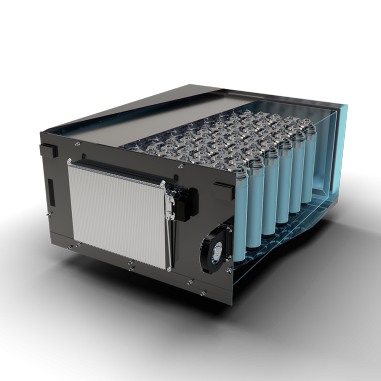
CeraSalt® industrial module (380V)
The benefits of CeraSalt®
Thanks to its design, CeraSalt® offers numerous advantages for stationary applications:
- CeraSalt® uses only raw materials that are abundant in Europe and extracted in an environmentally friendly manner.
- CeraSalt® is extremely safe. Unlike lithium-ion batteries, this energy storage system cannot catch fire or explode—a crucial factor, especially for stationary use in residential buildings.
- No critical substances are released during the operation of CeraSalt®.
- CeraSalt® is completely maintenance-free.
- CeraSalt® requires neither air conditioning nor individual cell monitoring, even at higher ambient temperatures.
- CeraSalt® is exceptionally durable; a service life of over 10 years can be expected based on approximately one charge cycle per day.
- CeraSalt® is infinitely scalable. The system can be precisely tailored to specific needs, whether for a private photovoltaic system, an industrial facility, or a wind farm.
- The underlying technology is mature, having undergone field testing for around 30 years.
CeraSalt®
Technical Data
Both modules and systems are constructed based on two CeraSalt® cells:
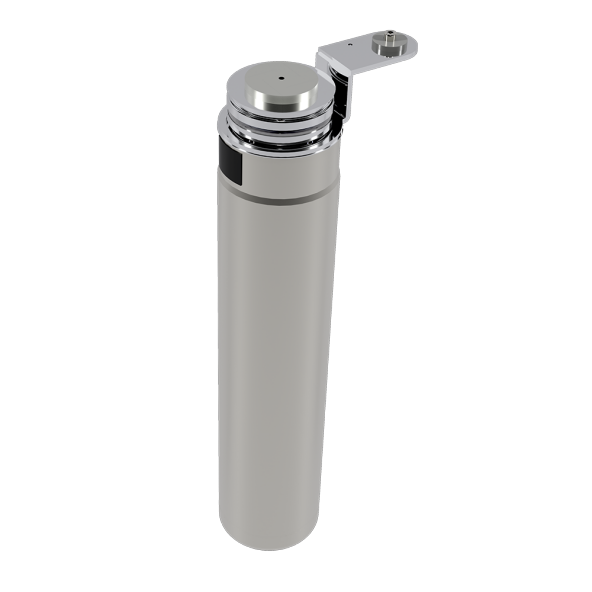
CeraSalt® STC-140 Cell
CeraSalt® STC-140
Parameter / Value
Capacity at C/4: 140 Ah
Open Circuit Voltage: 2.58 V
Rated Energy: 320 Wh
Max. Current: 100 A
Rated Power: 64,4 W (C/4)
Peak Power (SOC > 50%): 126 W
Weight: 2.30 kg
Dimensions (ø x h): 70 x 362 mm
CeraSalt® STC-250
Parameter / Value
Capacity at C/4: 250 Ah
Open Circuit Voltage: 2.58 V
Rated Energy: 570 Wh
Max. Current: 80 A
Rated Power: 45,6 W (C/4)
Peak Power (SOC > 50%): 85,5 W
Weight: 3,8 kg
Dimensions (ø x h): 84 x 362 mm
©CeraSalt GmbH. All Rights reserved.